ESL vs Traditional Paper Price Tags: Which Is Right for Your Store?
Compare electronic shelf labels and traditional paper price tags across cost, labor, accuracy, speed, ROI, and sustainability to find the right retail pricing solution.
When comparing ESL vs paper price tags, retailers need to consider more than the initial purchase cost. Traditional paper labels are inexpensive and familiar, but electronic shelf labels offer advantages in price updates, labor efficiency, and pricing accuracy. This guide compares both options across seven key factors, including cost, labor, speed, ROI, sustainability, and customer trust, to help retailers choose the right solution.
ESL vs Paper Price Tags: Quick Comparison
| Factor | Electronic shelf labels | Paper price tags |
| Upfront cost | Significant (labels, base stations, software, installation) | Minimal |
| Ongoing cost | Maintenance, software, battery replacement | Paper, ink, printing and staff time every change |
| Price update speed | Seconds to minutes, done remotely | Printed and swapped by hand, often hours or days |
| Pricing accuracy | Shelf and register prices come from one source | Prone to human error and shelf/POS mismatches |
| Labor | Frees staff from label changes | Labor-intensive |
| Sustainability | Paperless | Paper and ink waste |
| Best fit | Large ranges, frequent price changes | Small shops with few products and rare price changes |
The comparison points above follow Vusion’s published comparison, and Vusion is an ESL vendor, so treat the framing with that in mind. The sections below test it against independent figures and case studies.
New to ESLs? Read our primer on what electronic shelf labels are and how ESL systems work.
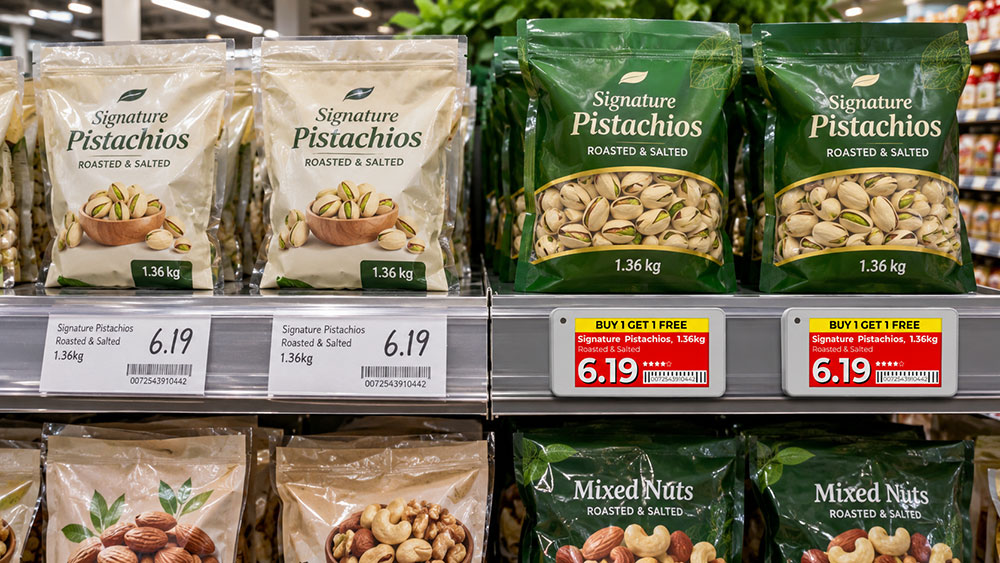
1. Cost: Upfront Investment vs Running Costs
Paper wins on day one. A printer and paper stock cost little, and no system integration is needed.
ESLs require a larger investment. Typical market ranges put a single label at roughly $5 to $20 or more, with additional costs for base stations, software and installation. An average supermarket carries 100,000 or more products, according to a 2025 academic study reported by KUTV, so the label count can be large. Our ESL cost per label guide breaks down each line item.
The question is what paper costs over time: printing supplies plus the staff hours spent printing, cutting, placing and correcting labels. East of England Co-op, which is rolling out Pricer ESLs across its stores, reported that store printing costs fell by 50%.
2. Labor: Where ESLs Usually Pay Back
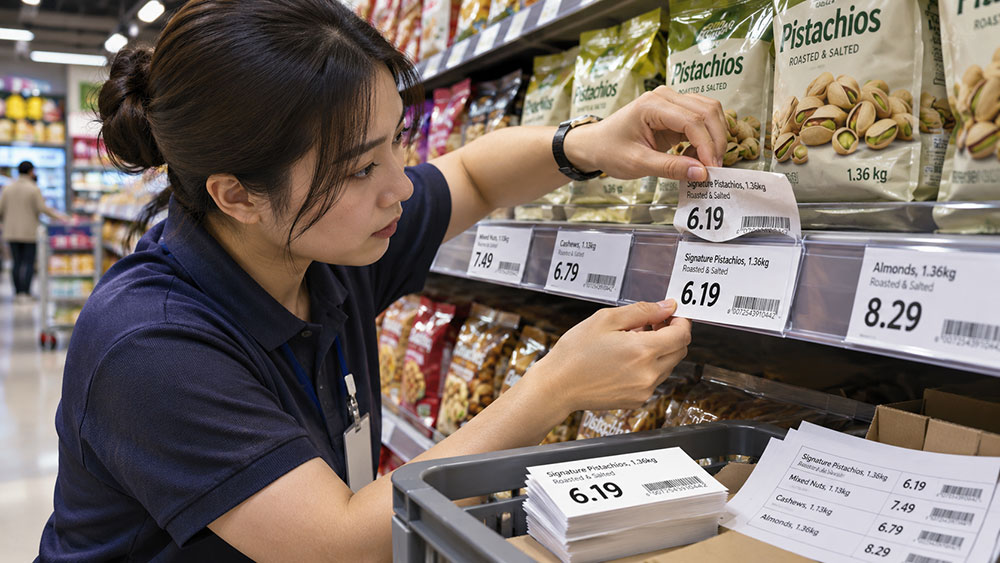
Labor is the biggest hidden cost of paper tags.
- East of England Co-op: estimated time spent maintaining paper labels fell by about 70%, from tens of thousands of labor hours a year.
- Jardiland (France): after switching to SES-imagotag ESLs across a group of 216 stores, price-display management time fell by roughly three-quarters, saving about 6 hours per store per week.
- Walmart: price changes that once took roughly two days in a supercenter carrying more than 120,000 products can now be completed in minutes through a mobile app.
Note that these are retailer or vendor-reported results. Savings scale with how many labels you change and how often.
3. Pricing Accuracy and Compliance
With paper, the shelf price and the register price are maintained separately, so mismatches happen. Jardiland reported a tenfold drop in customer complaints about pricing errors after adopting ESLs.
Electronic shelf labels can help reduce pricing mismatches by supporting more consistent price updates between retail management systems and shelf displays. Actual improvements depend on system integration, store operations, and implementation quality.
4. Speed and Promotion Flexibility
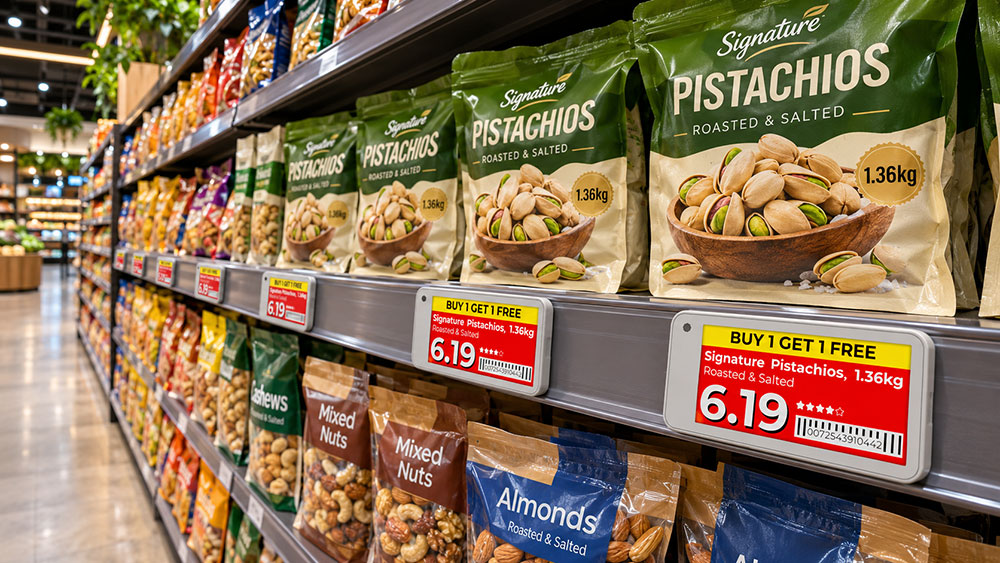
Paper labels must be reprinted and replaced by hand for every promotion, markdown and price change. ESLs update remotely, which makes it practical to run short promotions, mark down fresh food near expiry, or react quickly to supplier cost changes. This speed also supports omnichannel work: ESLs can flash an LED to guide staff to a product, as Walmart does for online order picking.
5. ROI and Payback Period
Payback depends heavily on store type. ISN Magazine reports the following typical payback ranges, again as benchmarks rather than audited results:
| Store type | Reported payback |
| High-volume supermarkets | 3 to 12 months |
| Mid-size grocery stores | 12 to 18 months |
| Large chains (system-wide) | 18 to 36 months |
6. Sustainability and Customer Trust
ESLs remove recurring paper and ink use, which supports sustainability goals. Customer trust is more nuanced. Many shoppers worry that instant price changes enable “surge pricing.”
An academic study by researchers at the University of Texas at Austin, UC San Diego and Northwestern University examined 2019 to 2024 price data from a grocery chain that adopted digital labels in October 2022. It found virtually no surge pricing: temporary price increases affected about 0.005% of products on a given day before adoption, and the share rose by only 0.0006 percentage points afterward. Discounts became slightly more common. Even so, some US state lawmakers have proposed limits on digital labels, so check local regulations and communicate clearly with customers.
7. When Paper Is Still the Better Choice
ESLs are not automatically the right answer. Paper may be the smarter option if:
- You run a small store with a limited range.
- Prices change rarely.
- Your shelving is irregular or temporary.
- You cannot yet integrate your pricing system.
Many retailers start with a pilot in one department or one store before committing, which limits risk. Our ESL installation guide explains how to plan one.
Frequently Asked Questions: ESL vs Paper Price Tags
Are electronic shelf labels better than paper price tags?
For stores with large ranges and frequent price changes, ESLs usually win on labor, accuracy and speed. For small stores with stable prices, paper can be more economical.
Are electronic shelf labels more expensive than paper?
Yes upfront. Labels commonly cost about $5 to $20 each plus infrastructure, while paper costs very little to start. Over several years, labor and printing savings can offset the difference.
How long until ESLs pay for themselves?
Reported paybacks range from a few months in high-volume supermarkets to one to three years for most retailers, depending on size and how often prices change.
Do ESLs lead to higher prices or surge pricing?
One academic study of a grocery chain found virtually no surge pricing after adoption. Policy is still evolving, so follow local rules.
Can I use ESLs and paper tags together?
Yes. Many retailers phase in ESLs by department or store and keep paper for low-change areas.
Do ESLs reduce pricing errors?
Because shelf and register prices come from one source, they reduce mismatches. Reported reductions vary, so measure your own baseline.
How long do ESLs last compared with paper?
Paper is replaced constantly. ESL batteries typically last several years, with industry averages around 3 to 6 years and some models rated longer.
Conclusion
The choice between ESL vs paper price tags depends on store size, product range, and price-change frequency. Electronic shelf labels can reduce manual pricing tasks and support faster updates, while paper labels may remain practical for smaller stores with stable prices. Retailers should evaluate their current labeling costs and consider a pilot project before making a full-scale investment.